Article Highlights
- AI is making modern cars smarter through advanced driver assistance and predictive safety technologies.
- Autonomous driving is becoming more sophisticated as AI systems learn from enormous amounts of real-world driving data.
- AI can improve electric vehicle efficiency through smarter battery management, navigation, and energy optimization.
- Predictive maintenance could help drivers identify developing vehicle problems before they become expensive failures.
- The future of automotive AI depends on safety, transparency, cybersecurity, privacy, and earning driver trust.
Artificial intelligence is no longer something reserved for technology companies and research laboratories. It is becoming part of the modern automobile, influencing how vehicles are designed, manufactured, driven, serviced, and even how drivers interact with them. From advanced driver assistance systems to predictive maintenance and intelligent voice assistants, AI is changing the car from a machine that follows commands into a system that can interpret information and respond to its surroundings.
The most important point is that AI is transforming the automotive industry in ways that drivers can already experience. Some changes are obvious, such as automatic emergency braking or adaptive cruise control. Others happen quietly in the background, including battery management, manufacturing quality control, navigation predictions, and software optimization.
As the technology develops, AI is transforming the automotive industry at an increasingly rapid pace. However, the transition also brings questions about safety, privacy, reliability, cybersecurity, cost, and how much control drivers should give to software.
What AI Means for the Modern Car
Traditional vehicle systems generally work according to predefined rules. Engineers program specific responses to specific situations. AI introduces another approach. Machine learning systems can process large amounts of information and identify patterns that would be difficult to manage through conventional programming alone.
A modern vehicle can collect information from cameras, radar, ultrasonic sensors, GPS, vehicle systems, and other sources. AI can then help interpret that information and make predictions or recommendations.
This does not mean every modern vehicle is self-driving. In fact, the distinction is extremely important. The National Highway Traffic Safety Administration explains that Level 2 driver assistance systems still require the driver to remain fully engaged and attentive, while Level 3 through Level 5 automated driving systems are not currently available for consumer purchase in the United States.
That distinction should remain clear whenever we discuss AI in cars.
AI Is Transforming the Automotive Industry Through Driver Assistance
One of the most visible areas where AI is transforming the automotive industry is advanced driver assistance.
Features such as automatic emergency braking, lane-keeping assistance, adaptive cruise control, blind spot monitoring, traffic sign recognition, and pedestrian detection rely on sophisticated sensors and software. Some systems can recognize a potential collision and react faster than a driver might be able to react.
NHTSA describes the development of vehicle safety technology as a progression from systems that warn drivers toward technologies that can intervene to help prevent crashes.
The practical benefit is easy to understand. Imagine driving on a highway when traffic ahead suddenly slows. A driver may need to notice the change, understand the closing distance, move a foot to the brake pedal, and react. An electronic system can continuously monitor the situation and intervene when programmed conditions are met.
This does not make the driver unnecessary. It gives the driver another layer of protection. That is one reason AI is transforming the automotive industry without immediately replacing human drivers.
AI Is Transforming With Smarter Autonomous Driving
Autonomous driving represents the most ambitious application of automotive AI. A self-driving system needs to understand what is around the vehicle, predict what other road users may do, plan a safe path, and control acceleration, braking, and steering. The challenge becomes much greater when pedestrians, motorcycles, construction zones, poor weather, unusual road layouts, and unpredictable human behavior are involved.
Modern AI research is increasingly moving toward systems that can learn driving behavior from very large datasets rather than depending entirely on manually programmed rules. McKinsey reported in June 2026 that generative AI is accelerating the development of AI native and end-to-end approaches to autonomous driving.
There are already real-world examples. Waymo reported in June 2026 that its autonomous driving system had accumulated more than 220 million fully autonomous miles through March 2026. In its own analysis, Waymo reported fewer serious or fatal injury crashes and fewer injury-related crashes compared with human drivers in the same operating areas. These are company-reported results, so they should be considered in that context rather than treated as a universal guarantee for autonomous driving.
The broader lesson is that AI Is Transforming the Automotive Industry by moving automated driving from a laboratory concept toward real-world deployment in limited locations and operating conditions.
The Driving Experience Is Becoming More Personal
AI is also changing what happens inside the cabin.
Instead of requiring drivers to navigate complicated menus, intelligent assistants can understand natural language and perform certain tasks through voice commands. A driver may be able to ask for navigation assistance, adjust cabin settings, select media, or obtain information without manually operating multiple screens.
The next stage could be even more personalized.
An AI-powered vehicle could learn recurring preferences such as preferred routes, cabin temperature, seating position, charging habits, and frequently visited destinations. The system could potentially recognize patterns and make useful suggestions before the driver asks.
There is a significant difference between useful personalization and intrusive technology, however. Drivers should be able to understand what information their vehicle collects and how that information is stored or shared. Convenience should not automatically come at the cost of privacy.
AI Is Transforming the Automotive Through Predictive Maintenance
Another important change is happening under the hood.
Vehicles already contain numerous sensors that monitor temperatures, pressures, electrical systems, batteries, engine components, and other systems. AI can analyze this information and identify patterns that may indicate an emerging problem.
This creates the possibility of predictive maintenance.
Instead of waiting for a component to fail or relying entirely on a fixed service interval, an intelligent vehicle could identify unusual behavior and alert the owner that inspection may be worthwhile.
For example, if a vehicle detects a gradual change in battery performance, abnormal vibration, or unusual thermal behavior, software could potentially identify the pattern earlier than a traditional warning system.
The technology is not a replacement for professional mechanical inspection. AI predictions can be wrong, and physical components still need qualified technicians. But predictive diagnostics can make maintenance more proactive.
For vehicle owners, this could mean fewer unexpected breakdowns and better understanding of a car’s condition.
AI Is Transforming the Automotive Industry and Electric Vehicles
Artificial intelligence is especially important for electric vehicles.
An EV has to manage energy consumption carefully because range depends on factors such as speed, temperature, traffic, road conditions, battery condition, cabin climate, and driving style.
AI can help optimize several of these variables.
An intelligent energy management system can analyze driving conditions and estimate how much energy the vehicle is likely to use. Navigation systems can consider traffic and elevation changes when calculating routes. Battery management software can monitor battery behavior and help optimize charging and thermal control.
This becomes increasingly valuable as automakers compete not only on battery capacity but also on efficiency.
Two vehicles with similar battery sizes can deliver different real-world results because software, aerodynamics, weight, tires, thermal management, and driving conditions all influence energy consumption.
AI is therefore becoming another tool for extracting more usable performance from existing hardware.
AI Is Improving Vehicle Manufacturing
The impact of AI Is Transforming the Automotive Industry is not limited to the vehicles customers drive.
Factories are also becoming more intelligent.
Manufacturers can use computer vision systems to inspect components, identify defects, monitor production lines, and detect inconsistencies. AI can analyze manufacturing data and help identify patterns associated with equipment problems or quality issues.
Robotics already plays a major role in modern vehicle manufacturing. AI can make these systems more adaptable by helping machines interpret visual information and respond to changing production conditions.
For manufacturers, the objective is not simply to build cars faster. Better quality control can reduce waste, improve consistency, and identify potential problems earlier.
This is particularly important as vehicles become more software-intensive and technologically complex.
AI Is Changing Car Design and Engineering
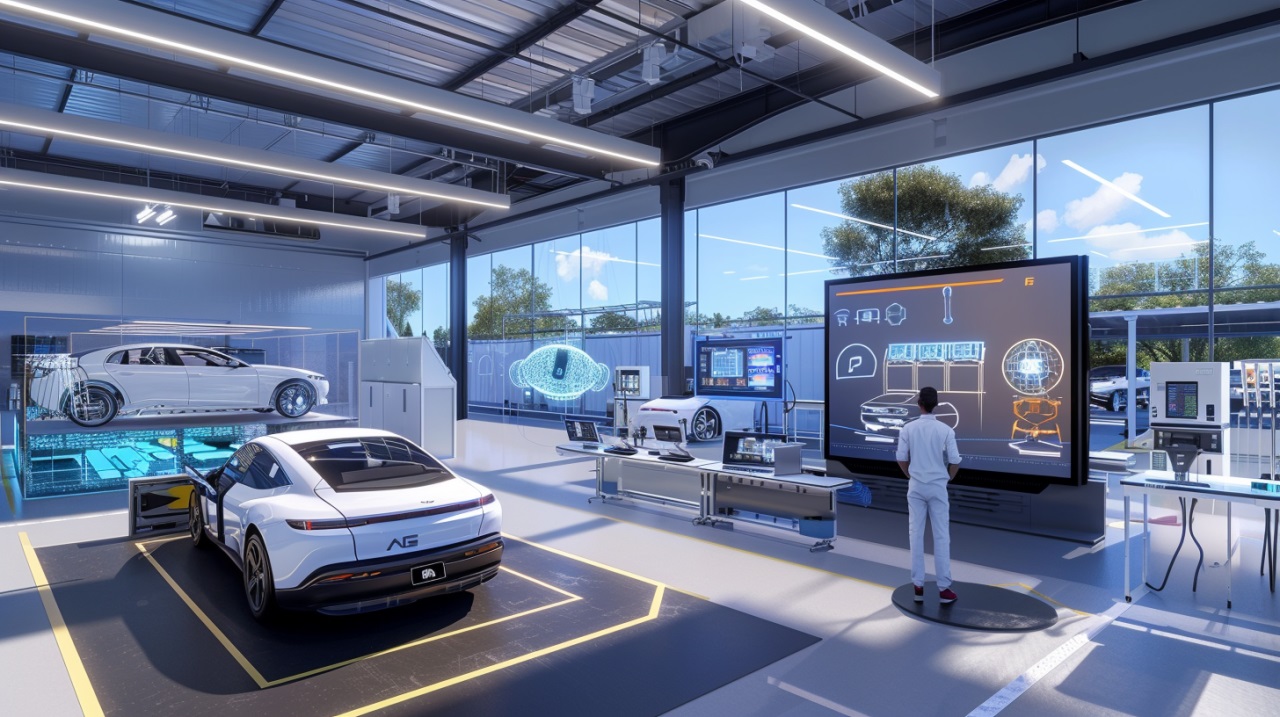
Artificial intelligence is also influencing how vehicles are developed before they reach a factory. Engineers can use computational tools to analyze enormous numbers of design possibilities. AI can assist with aerodynamic development, component optimization, battery research, simulation, and software development.
Instead of testing every idea exclusively through physical prototypes, engineers can increasingly use digital simulation to narrow down possibilities before building physical parts.
This can save time and resources.
It can also change the relationship between hardware and software. The modern vehicle is increasingly a software-defined product, meaning that important capabilities can depend heavily on software rather than only on physical components.
As AI systems become more capable, the development process itself is becoming more data-driven.
AI Is Transforming the Automotive Industry Through Connected Vehicles
Connected vehicles generate enormous amounts of information.
Navigation data, traffic information, charging availability, weather conditions, vehicle diagnostics, and road information can all contribute to a more intelligent driving experience.
Imagine approaching a congested road while your vehicle knows about the traffic several kilometers ahead. Instead of simply showing a red line on a map, an intelligent system could estimate how the traffic will affect your arrival time and recommend an alternative route.
The same concept can apply to electric vehicle charging. A vehicle could consider battery level, driving distance, traffic, temperature, and available charging locations when recommending where and when to recharge.
The more useful the information becomes, the more important data management becomes as well.
Generative AI Could Change the Car’s Interface
Generative AI could become one of the most noticeable changes inside future vehicles. Traditional voice assistants often struggle when drivers use natural language or ask complicated questions. Generative AI offers a more conversational approach.
A driver could potentially say something like, “Find me a quieter route home and avoid roads with heavy traffic,” rather than navigating through several menus.
The assistant could understand context and respond conversationally.
However, there is an important safety limitation. A conversational system should not become a distraction. Drivers need interfaces that make common tasks easier without encouraging them to spend more time interacting with screens.
The best automotive AI may therefore be the technology that requires less attention rather than more.
AI Is Transforming the Automotive Industry, but Safety Must Come First
The biggest challenge for automotive AI is not whether a computer can perform an impressive task. The bigger question is whether it can perform that task reliably in the unpredictable real world.
Roads are messy environments.
A temporary construction sign may be placed differently from normal signs. A pedestrian may suddenly step into traffic. A motorcycle may move between lanes. Heavy rain can affect visibility. A road marking may be faded or completely missing.
AI systems must be tested against enormous numbers of situations, including unusual ones. Regulators are also paying close attention to these systems. NHTSA requires certain manufacturers and operators to report specified crashes involving Level 2 ADAS and automated driving systems, allowing the agency to investigate potential safety concerns.
That oversight matters because impressive demonstrations are not enough. Automotive technology has to work consistently under real-world conditions.
Drivers Should Understand the Limits of AI
One mistake consumers can make is assuming that an AI-assisted vehicle is capable of driving itself everywhere.
It is not safe to make that assumption.
A system may work extremely well on highways but have limitations on local roads. Another feature may operate only under certain speeds or weather conditions. A driver assistance system may control steering and speed but still require constant driver attention.
The technology should always be used according to the manufacturer’s instructions.
When buying a new vehicle, drivers should look beyond marketing terms and determine exactly what the system can do, where it works, and what responsibilities remain with the driver.
Understanding those limitations is just as important as understanding the vehicle’s horsepower or fuel economy.
AI and the Future of Vehicle Ownership
AI could eventually change the relationship between people and their cars. Today’s ownership model is largely reactive. Something breaks, a warning light appears, or a service interval arrives.
Future vehicles could become more proactive.
The car might tell the owner that a tire is losing pressure, recommend a charging time based on the next day’s schedule, suggest maintenance based on component behavior, or automatically update certain software functions.
This could make ownership easier.
At the same time, consumers will need greater transparency. If software determines important vehicle functions, owners should understand what can be updated, what information is collected, and what happens if a connected service stops working.
The smartest car should still give its owner a clear sense of control.
What AI Means for Drivers in 2026
In 2026, AI Is Transforming the Automotive Industry, but the transformation is still developing. Drivers can already experience AI-influenced safety systems, smarter navigation, predictive features, connected services, automated parking assistance, intelligent cabin functions, and increasingly advanced driving assistance.
However, fully autonomous personal vehicles capable of handling every driving situation remain a future goal rather than a universal consumer reality. NHTSA states that currently available consumer vehicles still require driver attention and that fully automated driving systems are not currently available for consumer purchase.
That distinction is important because automotive AI is often discussed as if the future has already arrived.
It has not.
Instead, we are in an intermediate stage where vehicles are gradually becoming more capable while humans remain responsible for driving in most consumer applications.
What Buyers Should Look For in an AI-Enabled Car
When shopping for a modern vehicle, it is tempting to choose the model with the longest list of technology features. A better approach is to consider whether those features actually improve everyday driving.
Look for driver assistance systems that are easy to understand and operate. Check whether the vehicle provides clear warnings when a system is unavailable or requires driver intervention.
Consider the quality of the cameras and sensors, the behavior of adaptive cruise control, lane assistance performance, emergency braking capability, navigation quality, and the clarity of the vehicle’s interface.
For electric vehicles, battery management and route planning can be just as important as screen size or acceleration.
Most importantly, do not judge AI technology by the number of features advertised. Judge it by how reliably and naturally those features work.
The Road Ahead for Automotive AI
The next phase of automotive technology will probably be less about adding isolated features and more about connecting them.
A vehicle may combine driver monitoring, navigation, safety systems, vehicle diagnostics, battery management, infotainment, and personal preferences into one intelligent platform.
This could make the car feel less like a collection of independent computers and more like one coordinated system.
AI Is Transforming the Automotive Industry because it allows software to interpret complex information and respond to changing conditions. The result could be safer vehicles, more efficient electric cars, smarter manufacturing, easier maintenance, and a more personalized driving experience.
But technology should never be judged only by how advanced it appears.
The most successful automotive AI will be the technology that earns the driver’s trust through predictable behavior, transparent limitations, strong safety validation, and genuine usefulness.
That is ultimately where the future of the automobile is heading. The car is becoming smarter, but the goal should not be to make technology impressive for its own sake. The goal should be to make transportation safer, easier, more efficient, and more enjoyable for the people who use it.
For readers following the latest developments in Auto Updates, AI will remain one of the most important technologies to watch as automakers continue redefining what a modern vehicle can do.
Frequently Asked Questions
What is AI doing in modern cars?
AI is used in areas such as driver assistance, object detection, predictive maintenance, navigation, voice assistants, battery management, vehicle diagnostics, and manufacturing. The exact capabilities vary significantly between vehicles and manufacturers.
Is AI making cars fully self-driving?
Not generally. Most consumer vehicles with advanced AI-based driver assistance still require the driver to remain attentive and responsible. NHTSA currently distinguishes driver assistance systems from higher levels of automated driving that are not available for general consumer purchase.
How does AI improve vehicle safety?
AI can help vehicles interpret information from cameras and other sensors, detect potential hazards, warn drivers, and in some situations automatically intervene. Technologies such as automatic emergency braking and lane assistance can help reduce the risk or severity of certain crashes.
Can AI predict car problems?
AI can analyze vehicle data and identify patterns that may indicate a developing problem. Predictive maintenance can potentially alert owners before certain failures occur, although it should not replace professional inspection or manufacturer-recommended maintenance.
How does AI help electric vehicles?
AI can help optimize energy use, battery management, charging strategies, route planning, and thermal control. These systems can potentially improve efficiency and make EV range management more predictable.
Will AI change how drivers interact with cars?
Yes. Voice interfaces, personalized settings, predictive recommendations, intelligent navigation, and conversational assistants are likely to make vehicle interaction more natural. The challenge will be making these systems useful without creating additional driver distraction.
Is AI safe for use in vehicles?
AI can provide important safety benefits, but its reliability depends on the system, its operating conditions, testing, and how the driver uses it. No driver should assume that an assistance system can handle situations beyond its stated capabilities.
Will AI replace human drivers?
It may eventually automate more driving tasks, but the timeline and extent of that change remain uncertain. Different technologies are progressing at different speeds, and regulatory, technical, safety, and consumer acceptance issues will continue to influence adoption.
My Personal Opinion
AI Is Transforming the Automotive Industry from the factory floor to the driver’s seat. It is helping vehicles understand their surroundings, assisting drivers, managing energy, predicting maintenance needs, improving manufacturing, and creating more personalized experiences.
The most meaningful change may not be a futuristic car that suddenly drives everywhere by itself. It may be the gradual integration of intelligence into hundreds of everyday vehicle functions.
As AI Is Transforming the Automotive Industry, consumers should focus on practical benefits rather than impressive terminology. A system that prevents a crash, makes an EV more efficient, identifies a maintenance problem early, or makes navigation easier can have far more value than a flashy feature that rarely gets used.
The automotive industry is entering a new technological era, and AI will be one of the forces defining it. The challenge now is making that intelligence dependable enough to deserve the trust that drivers place in their vehicles.