Article Highlights
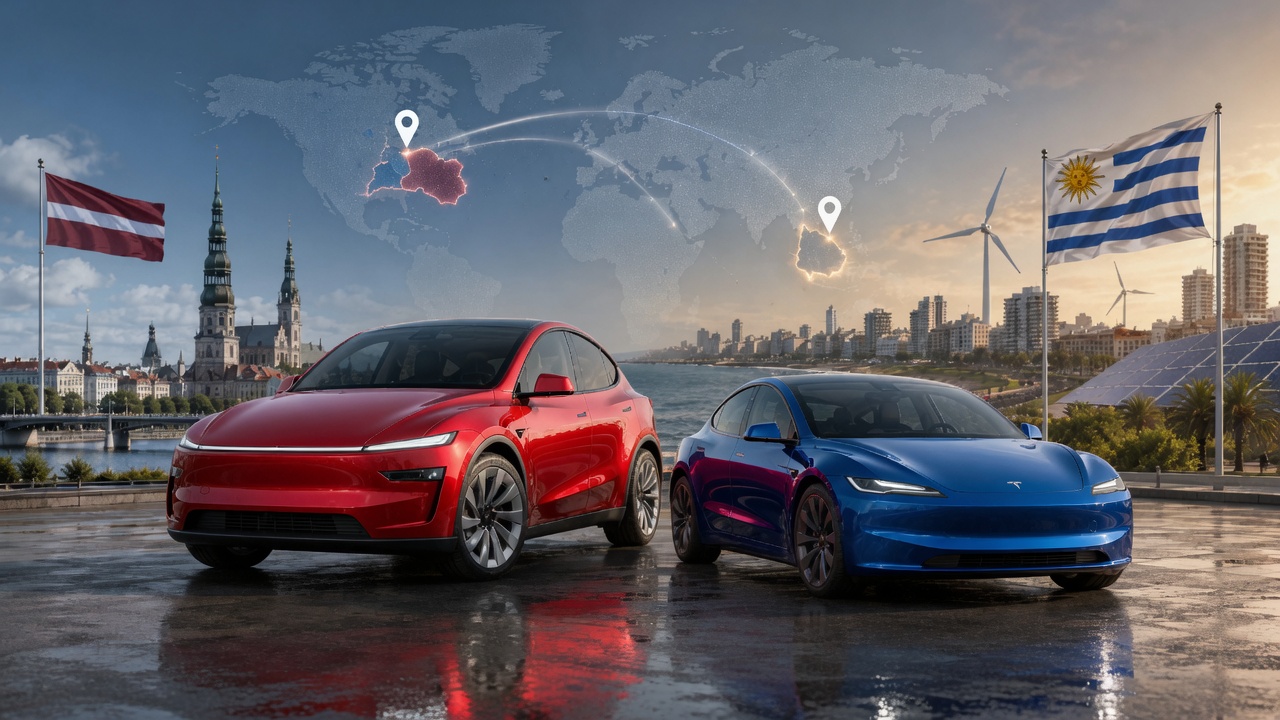
- Tesla entered Latvia and Uruguay within 24 hours, completing its full Baltic rollout and adding a third South American market after Chile and Colombia.
- Latvia will get its first physical Tesla location on August 21, a pop-up store at the Spice shopping center in Riga, with online ordering already available.
- Uruguay stands out for its clean energy, generating ninety-nine percent of its electricity from renewables in 2024, making it Tesla’s most renewables-powered market globally.
- EV adoption in Uruguay jumped from about twenty percent in 2025 to twenty-nine percent by April 2026, one of the highest rates in the Americas.
- The dual launch reflects Tesla’s broader strategy of targeting smaller, fast-growing markets as sales slow in the US, Europe, and China.
Tesla has once again shown that its global growth strategy is not slowing down, even as sales soften in its biggest markets. Within a span of just 24 hours, the company confirmed new market entries in Latvia and Uruguay, two very different countries on two different continents. This move marks a fresh chapter for the automaker as it looks beyond its traditional strongholds and taps into smaller but promising regions. The Tesla Latvia and Uruguay expansion is a clear signal that the company is willing to chase growth wherever it can find it, even in markets that register far fewer vehicles each year compared to giants like the United States or China.
A Baltic Milestone in Latvia
The Tesla Latvia and Uruguay launch completes something Tesla has been building toward for a couple of years now. Latvia is the final piece of the Baltic puzzle, following earlier launches in Lithuania back in 2024 and Estonia earlier this year. With this announcement, Tesla now has an official presence across all three Baltic states, giving the brand a complete regional footprint in that part of Europe.
Tesla plans to open its first physical location in Latvia on August 21, choosing a pop-up store format at the Spice shopping center in Riga. This approach mirrors what worked well in Lithuania, where a smaller retail footprint helped the company test demand before committing to larger investments. Even before the store opens its doors, Latvian customers are already able to configure and order the Model 3 and Model Y online, which is a smart way to build early interest ahead of the physical launch.
Electric vehicle adoption in Latvia currently sits around seven percent for battery electric vehicles among new passenger car registrations. That number may seem modest, but it shows there is room for growth, and Tesla clearly wants to be part of that story early rather than waiting for the market to mature further. Vehicles sold in Latvia are expected to come from Gigafactory Berlin or possibly Gigafactory Shanghai, depending on logistics and demand. The charging network in the region is already fairly developed, too, with Tesla Superchargers present in Riga, Jurmala, and along the Via Baltica corridor, some offering speeds up to 250 kW.
Uruguay Becomes Tesla’s Third South American Market
On the other side of the Atlantic, the Tesla news in Latvia and Uruguay also brought something significant for South America. Uruguay is now the third country on that continent where Tesla officially operates, joining Chile and Colombia in the growing list of Latin American markets. The company teased this arrival with the phrase Estamos llegando, meaning We are arriving, which built anticipation before the formal announcement.
At first glance, Uruguay might not seem like an obvious priority. The country registers fewer than fifty thousand new vehicles a year, which is tiny compared to most established Tesla markets. But the numbers behind that small figure tell a much bigger story. Electric vehicles made up roughly twenty percent of the Uruguayan market in 2025, and that share climbed to twenty-nine percent by April 2026. That kind of adoption rate puts Uruguay among the fastest-growing EV markets anywhere in the Americas.
What makes Uruguay even more interesting is its electricity grid. In 2024, the country generated ninety-nine percent of its electricity from renewable sources. This makes it the most renewables-powered market that Tesla sells anywhere in the world. For a company whose entire mission centers on sustainable energy, entering a market where the grid is already almost entirely clean fits perfectly with that long-term vision. Buyers in Uruguay will have access to the Model 3 and Model Y, along with local support and the same online ordering convenience being offered in Latvia.
Why These Two Markets Matter Right Now
Neither Latvia nor Uruguay will move Tesla’s overall global sales numbers in a dramatic way on its own. Both are small markets by any measure. But the timing and pattern behind these launches say a lot about where Tesla’s strategy is heading. Sales have slowed in the company’s core markets, including the United States, Europe as a whole, and China. When growth stalls in the biggest regions, filling in gaps on the map with smaller but promising markets becomes one of the more reliable ways to keep adding incremental volume.
This is exactly what the Tesla Latvia and Uruguay expansion represents. Instead of waiting for conditions to improve in saturated markets, Tesla is spreading its presence wider, betting that many smaller wins can add up over time. Both countries also share something important beyond their size. Latvia offers a supportive regulatory environment within the European Union, along with growing EV interest. At the same time, Uruguay brings an already high adoption rate paired with one of the cleanest electricity grids on the planet.
For everyday buyers, the practical impact is straightforward. People in Latvia and Uruguay who previously had to import a Tesla informally or purchase through neighboring countries can now order directly, access local service support, and rely on an expanding charging network built specifically for their region. That kind of local presence tends to boost consumer confidence significantly, since buyers feel more secure knowing service centers and support teams are close by rather than across a border.
What This Means for Tesla’s Global Strategy
Looking at the bigger picture, the Tesla Latvia and Uruguay rollout fits into a broader pattern the company has followed throughout 2026. Rather than doubling down only on massive markets, Tesla appears to be diversifying its geographic footprint, entering smaller countries where EV adoption is already trending upward or where the energy infrastructure aligns naturally with electric vehicles. This strategy spreads risk and opens new revenue streams that are less dependent on the ups and downs of any single large market.
It also reflects something practical about how Tesla approaches new markets these days. The pop-up store model used in Latvia, much like the earlier Lithuania rollout, allows the company to test demand without a massive upfront investment in permanent infrastructure. If interest grows, Tesla can always expand its retail footprint later. This approach keeps expansion costs manageable while still giving local customers a real place to see and purchase vehicles.
For readers who follow the electric vehicle space closely, whether through outlets like WheelsWind or elsewhere, these two launches offer a useful case study. They show that even a company as large as Tesla still values methodical, market-by-market growth rather than relying purely on its established regions. The Tesla Latvia and Uruguay expansion may be small in terms of immediate sales volume. Still, it reinforces a long-term pattern of the company chasing opportunity wherever it exists, one new market at a time.
As more details emerge about pricing, delivery timelines, and additional store locations in both countries, it will be worth watching how quickly demand builds. Given the EV adoption trends already visible in Uruguay and the completed Baltic coverage that Latvia represents, both markets seem well-positioned to become steady, if modest, contributors to Tesla’s global footprint in the years ahead.