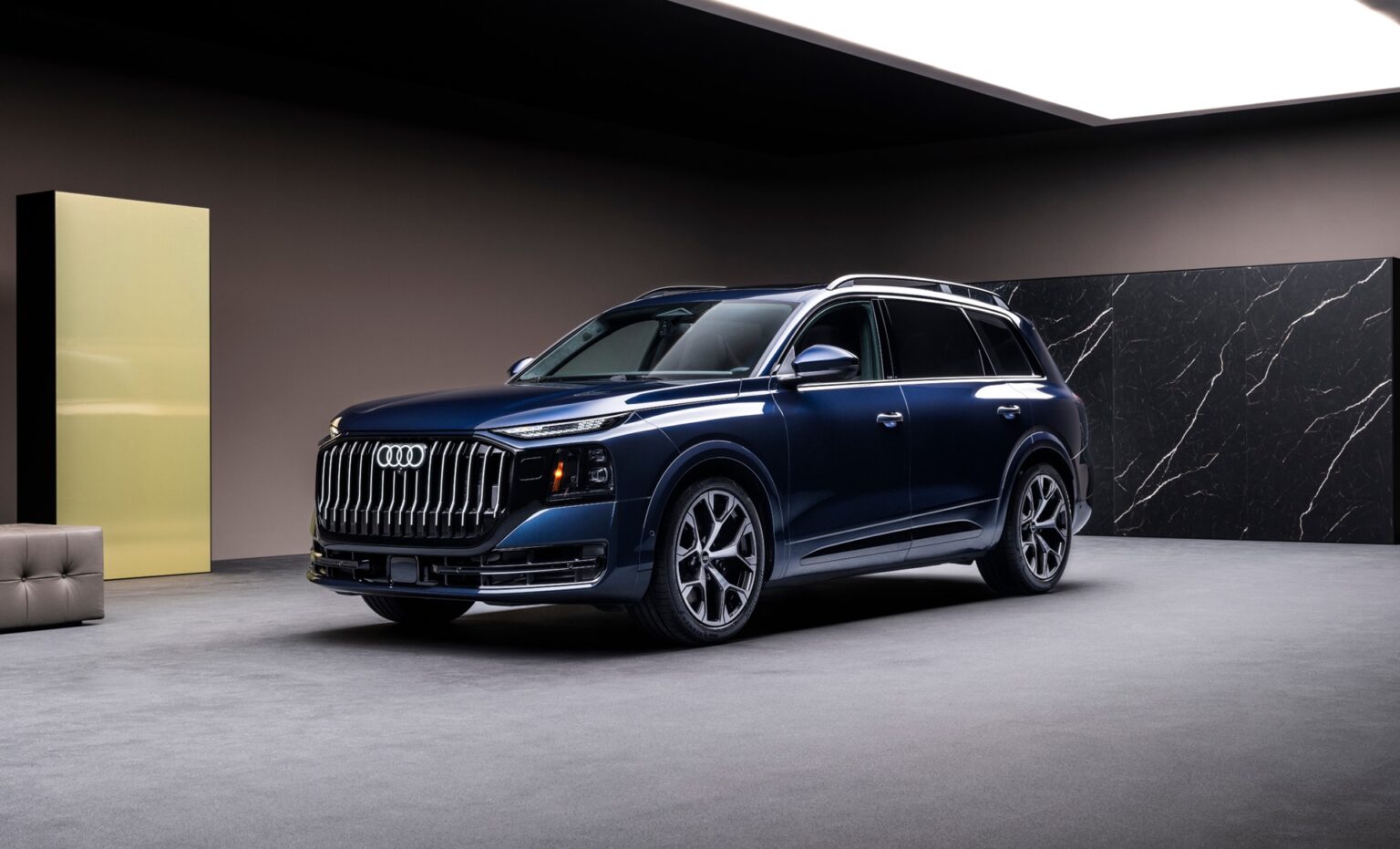
I have spent years testing luxury SUVs for a living, and one thing has always stood out about Audi’s lineup: it was missing a true flagship. While BMW had the X7 and Mercedes had the GLS Class, Audi buyers who wanted something bigger than the Q7 had nowhere to go inside the brand. That finally changes with the new Q9, and after digging into everything Audi has revealed about this SUV, I have a lot of thoughts on whether bigger actually means better.
This new Audi SUV is not a clean sheet design. It borrows heavily from the recently redesigned Q7, and that shows in both the good ways and the compromises. Below, I am breaking down what makes this Audi SUV different, where it genuinely improves on the brand’s lineup, and where I think Audi played it a little too safe.
Why Audi Waited So Long To Build A Bigger SUV
Audi built its first SUV, the Q7, back in 2007. That was already late compared to some rivals, but the bigger gap has always been at the top end. For nearly two decades, anyone who wanted a truly full-size Audi SUV had to look elsewhere in the German luxury world.
I think this delay says a lot about Audi’s strategy. The brand has generally been more conservative about chasing every segment, choosing instead to perfect the sizes it already builds. With the Q9, Audi is finally chasing the same buyers that the BMW X7 and Mercedes GLS Class have had mostly to themselves.
By Audi’s own numbers, SUVs now make up roughly 80 percent of the luxury market, so it is not hard to understand why the company decided the timing was right. A bigger Audi SUV was overdue, and the brand seems to know it.
What Makes This Audi SUV Bigger Than The Q7
The new Q9 is the largest Audi SUV the brand has ever built, though it is worth setting expectations here. It is not a dramatically different vehicle from the redesigned Q7, more like a stretched version of it.
Compared to the Q7, this Audi SUV is about 9.9 inches longer overall, with a wheelbase that grows by 5.6 inches. Width and height stay nearly identical between the two models. That extra length goes almost entirely toward passenger space and cargo room rather than a wider stance or a taller roofline.
Inside, second row passengers benefit the most, gaining a little over 2 inches of extra legroom compared to the Q7. Third row headroom also improves slightly, though third row legroom stays about the same. Audi’s own executives have explained that stretching the third row further would have added several more inches to the overall length, which the brand decided was not worth the tradeoff.
Cargo space grows across the board too. Behind the third row, behind the second row, and with all seats folded, this Audi SUV offers noticeably more room than the Q7 in every configuration.
Styling Built For One Market In Particular
I will be direct here. This Audi SUV was clearly designed with American buyers in mind, and the styling reflects that. The grille is larger and taller than anything else in Audi’s current lineup, closer in scale to what you would see on a Cadillac Escalade or Lincoln Navigator than a typical European Audi model.
The headlights sit lower with a heavier look, paired with slim daytime running lights above them. Around back, the roofline is more upright than the Q7’s, and the license plate mount sits lower, both choices that make the rear end look even larger.
Personally, I do not think this is Audi’s most elegant design. It works, and it certainly looks imposing in a school pickup line or a hotel valet stand, but it trades some of the brand’s usual restraint for sheer visual size. If you have followed Audi’s design language over the years, this Audi SUV feels like a departure in tone, even if the underlying shapes are familiar.
The Lighting Technology Is The Real Highlight
If there is one area where this Audi SUV genuinely pushes the brand forward, it is lighting. Audi is finally bringing its Digital Matrix LED headlight technology to the United States, roughly a decade after debuting it elsewhere. Each headlight reportedly uses tens of thousands of individually controlled elements, allowing the system to precisely aim light on the road without blinding oncoming drivers.
At the rear, the taillights use OLED technology that curves along nearly the full width of the tailgate. According to Audi engineers, the two lighting technologies serve different purposes. Conventional LEDs are better at projecting usable light onto the road ahead, while OLEDs are better suited to covering a wide, visible area at the back of the car.
There is also a turn signal feature that projects arrows onto the ground when you signal, which should make lane changes and turns easier for other drivers to anticipate. It is a small touch, but one that could genuinely improve real-world safety, assuming it performs as described once independent reviewers get real seat time.
Interior Comfort And Technology
Step inside this Audi SUV and the layout will feel familiar if you have sat in a recent Q7 or Q8. There is a digital instrument cluster, a large central touchscreen, and a second touchscreen for the front passenger, which together handle most functions since there are no manual air vent controls.
Audi added a few flagship touches to separate this Audi SUV from the rest of the lineup. Power-closing doors, an available 22-speaker premium audio system, and extended ambient lighting all contribute to a more upscale feel. The materials lean toward matte finishes rather than glossy plastic, which I personally prefer since it hides fingerprints and reduces glare.
One thing worth noting for families cross-shopping this Audi SUV against rivals: it does not offer reclining second row seats the way some competitors do. If you are looking for a chauffeur-style rear seat experience, this may not be the model that delivers it.
Powertrain: Capable, But Not Groundbreaking
Here is where I think Audi made its most conservative decision. This Audi SUV uses the same twin-turbo 2.9-liter V6 found in the Q7, producing 429 horsepower and 442 pound-feet of torque, paired with an eight-speed automatic and standard All Wheel Drive.
Despite the added size and weight, Audi’s own figures suggest this Audi SUV is only about a tenth of a second slower to 60 mph than the smaller Q7. That is a respectable outcome, and the horsepower figure is actually higher than the turbocharged inline six engines used in both the BMW X7 and Mercedes GLS Class, which does give this Audi SUV a real-world advantage in everyday acceleration.
Towing capacity is rated at up to 7,700 pounds, which is competitive for the segment. Adaptive air suspension and four-wheel steering come standard, giving the SUV a wide range of ride height adjustment and tighter low-speed maneuverability for its size.
If you want more performance, the SQ9 variant swaps in a twin-turbo 4.0-liter V8 shared with the SQ7, rated at 591 horsepower and 590 pound-feet of torque. Audi’s estimated 0 to 60 mph time for the SQ9 lands around 3.8 seconds, which is genuinely quick for a three-row SUV of this size.
How This Audi SUV Compares To The Competition
Having followed this segment closely, I think this Audi SUV lands in a sensible middle ground. It is not trying to out-luxury the Mercedes GLS Class, and it is not chasing the sheer road presence of the Cadillac Escalade. Instead, it aims to be the practical, tech-forward choice inside Audi’s own showroom.
Against the BMW X7 and Mercedes GLS Class specifically, this Audi SUV claims a horsepower and torque advantage in its base form, along with a slightly quicker claimed 0 to 60 mph time. Cargo space appears to be in a similar range to those German rivals, though not quite matching the largest American full-size SUVs in outright capacity.
One area where Audi still trails is advanced suspension technology. Mercedes offers its E Active Body Control system on the GLS Class, and there is currently nothing directly comparable on this Audi SUV. If ride sophistication at the very top end matters most to you, that is worth cross-shopping carefully.
Pricing And What To Expect
Based on Audi’s announced figures, this Audi SUV starts at 89,095 dollars for the standard model, with the performance-oriented SQ9 starting at 113,395 dollars. Both prices fall within the expected range for full-size luxury SUVs, though final pricing and trim availability can shift before the car actually reaches dealerships, so I would treat these as a starting point rather than a locked number.
Audi expects a significant share of Q9 sales, reportedly around 65 percent, to come from the United States. That tells you a lot about who this Audi SUV was actually built for, and it lines up with the styling and feature choices Audi made throughout the vehicle.
My Honest Take: Is It Actually Better?
After going through everything Audi has revealed, here is my honest opinion. This Audi SUV is a smart, safe expansion of an already strong lineup rather than a bold reinvention. It gives Audi loyalists a genuine flagship option, and it should appeal to buyers moving out of large sedans who want the higher seating position and easier entry that an SUV provides.
Where it falls short of true innovation is the powertrain and chassis, both of which are essentially carried over from the Q7 rather than developed specifically for this larger platform. The lighting technology is the clearest example of real engineering progress, and it is genuinely impressive on paper.
If you already like Audi’s design language and feature set, this Audi SUV gives you more room and more presence without asking you to learn a new interior layout or infotainment system. If you are cross-shopping purely on driving dynamics or cutting-edge chassis technology, I would recommend testing the Mercedes GLS Class as well before deciding.
This kind of detailed first look coverage is exactly the type of analysis you will find regularly in the Paradox Automotive section, where we break down new vehicle launches with an eye toward what actually matters for real buyers.
Frequently Asked Questions
Is this the biggest Audi SUV ever built?
Yes. Based on Audi’s own figures, this is the largest SUV the brand has produced, surpassing the Q7 in length, wheelbase, and cargo capacity.
How much bigger is this Audi SUV compared to the Q7?
It is roughly 9.9 inches longer overall with a 5.6-inch longer wheelbase, while width and height remain close to the Q7’s dimensions.
Does this Audi SUV have a third row?
Yes, it seats up to seven passengers across three rows, with slightly more third row headroom than the Q7 offers.
What engine does the base model use?
It uses a twin-turbo 2.9-liter V6 producing 429 horsepower and 442 pound-feet of torque, paired with an eight-speed automatic transmission and standard All Wheel Drive.
Is there a performance version of this Audi SUV?
Yes, the SQ9 variant uses a twin-turbo 4.0-liter V8 rated at 591 horsepower, with an estimated 0 to 60 mph time of around 3.8 seconds.
How much does this Audi SUV cost?
Based on Audi’s announced pricing, the standard model starts around 89,095 dollars, while the SQ9 starts around 113,395 dollars. Actual pricing at launch could vary slightly.
How does this Audi SUV compare to the BMW X7 and Mercedes GLS Class?
It claims a horsepower and torque advantage over both rivals in base form, along with a slightly quicker claimed acceleration time, though it lacks some advanced suspension technology available on the GLS Class.
What is new about the headlights on this Audi SUV?
It introduces Audi’s Digital Matrix LED headlight technology to the United States for the first time, allowing precise control over how light is projected on the road.
A Balanced Conclusion
This Audi SUV fills a real gap in the brand’s lineup, and on paper it does what it sets out to do. It is spacious, quick for its size, loaded with technology, and priced in line with its direct competitors. At the same time, it is fair to say Audi took a conservative path here, reusing an existing engine and platform rather than pushing into genuinely new territory.
Whether that makes this Audi SUV the right choice for you really depends on what you value most. Buyers who want a bigger, more capable Audi with familiar comfort and Audi’s latest lighting technology should be pleased. Buyers chasing the most advanced ride quality or the boldest new engineering may want to cross-shop before committing.
Note: Pricing, specifications, and availability details in this article are based on Audi’s announced figures at the time of writing and may change before the vehicle reaches dealerships. Always confirm current pricing and specs with a local Audi dealer before making a purchase decision.