Article Highlights
- Tesla shareholders submitted nearly 300 questions ahead of the Q2 2026 earnings call, with most focused on missed goals rather than future promises.
- Robotaxi delays remain the top concern, tracing back to Musk’s unfulfilled 2019 promise of one million robotaxis by 2020
- Optimus humanoid robot production is the second biggest worry, with shareholders demanding clarity on Gen 3 timelines.
- Some Tesla shareholders are directly asking Musk to commit to achieving at least half of his 2025 compensation plan goals.
- Wall Street analysts remain split, with price targets ranging from deeply bearish to cautiously optimistic.
Tesla shareholders are running out of patience, and this time they are not staying quiet about it. Ahead of the company’s Q2 2026 earnings call scheduled for July 22, retail investors have flooded Tesla’s shareholder Q&A portal with nearly 300 questions, and the tone has shifted noticeably. Instead of asking Elon Musk about the grand vision he loves to talk about, Tesla shareholders are now demanding straight answers about why so many of the company’s own targets keep slipping year after year.
Why Tesla Shareholders Are Losing Faith
For years, Tesla shareholders were willing to look past missed deadlines because the long-term story felt exciting enough to justify the wait. Robotaxis, humanoid robots, and fully autonomous driving all sounded like the kind of breakthroughs that could reshape entire industries. But patience has limits, and after watching several of these promises get pushed back repeatedly, many Tesla shareholders are no longer satisfied with vague updates about the future. They want specifics, and they want accountability.
Tesla runs its earnings Q&A through a platform called Say Technologies, where shareholders submit questions and vote on them based on how many shares they hold. This system usually gives a fairly accurate picture of what actually matters to the people who own the stock. This quarter, the picture is clear. Robotaxi delays sit at the top of the list, followed closely by concerns about the Optimus humanoid robot program, and a growing fear among some Tesla shareholders that Musk’s attention is drifting toward SpaceX and other ventures instead of staying focused on Tesla.
The Robotaxi Problem Keeps Growing
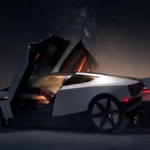
Back in 2019, Musk told the public that Tesla could have one million robotaxis on the road by the end of 2020. That target never came close to happening. Full Self Driving remained a supervised system that still required a human behind the wheel, not the fully autonomous experience that had been promised. Tesla later reset expectations during its Cybercab unveiling in October 2024, promising unsupervised robotaxi operations in Texas and California by 2025, along with volume production of Cybercabs by 2026.
A limited paid robotaxi service did launch in Austin in June 2025, and Cybercab production began earlier this year, but Musk himself admitted the ramp would be agonizingly slow. That kind of honesty might have been refreshing a few years ago, but for Tesla shareholders who have heard similar warnings before, it now feels like a pattern rather than an exception. Many are pointing out that the gap between what gets promised on stage and what actually reaches customers keeps widening instead of closing.
There is also a technical issue lurking underneath the robotaxi story. Older Tesla vehicles built with previous hardware generations may need physical upgrades to run the newer Full Self Driving software. Tesla has floated the idea of building micro factories to handle these retrofits, but industry observers have called this plan unlikely to materialize in any meaningful way. Admitting the true scale of this problem, along with the potential refund liability tied to it, would be an uncomfortable moment for a company that has sold the promise of self-driving cars for close to a decade without fully delivering it.
Optimus and the Compensation Question
Robotaxi delays are not the only source of frustration. Optimus, Tesla’s humanoid robot project, ranks as the second biggest concern among shareholder questions. People want to know the real status of Gen 3 production, when factory deployment will actually begin, and whether external sales are realistic by 2027. Tesla first talked about limited Optimus production back in 2023, then shifted the timeline toward low-rate production and internal use through 2026. Musk has described the Optimus ramp using the same phrase he used for robotaxis, calling it agonizingly slow and pointing to the fact that nearly every component in the robot is new.
Perhaps the most pointed questions this quarter come from Tesla shareholders asking Musk to commit to achieving at least half of the goals outlined in his 2025 compensation plan. This kind of question rarely gets asked so directly, and it signals a deeper anxiety among long-term investors. There is also concern about a possible merger between Tesla and SpaceX, something that would further complicate an already complicated picture for people trying to evaluate Tesla purely as an automaker and technology company.
What This Means for the Stock
Analysts remain divided on where Tesla is headed. Morgan Stanley raised its price target while maintaining a neutral rating, still viewing robotaxi and Optimus as the primary long-term value drivers. Barclays and Jefferies made similar adjustments without dramatically changing their outlook. On the other end, Wells Fargo maintained a much more cautious stance with a price target implying significant downside from current levels. This divide reflects exactly what Tesla shareholders themselves seem torn about right now. Some still believe in the long-term vision, while others are growing tired of hearing about the future when the present keeps falling short.
Long-time Tesla investor Ross Gerber has been especially vocal, describing 2026 as a make-or-break year for the company. He has publicly called for changes in leadership focus and argues that Musk’s time spent on other ventures has hurt Tesla at a moment when competition in the self-driving space is intensifying. Whether or not Tesla shareholders get the direct answers they are asking for on July 22 remains to be seen, but the questions themselves tell a story that is hard to ignore. For readers who follow the auto industry closely, sites like WheelsWind continue to track how these shifts in shareholder sentiment could shape Tesla’s next chapter.
At this point, Tesla shareholders are not asking for miracles. They are asking for honesty about timelines, clear updates on production numbers, and some acknowledgment that promises need to match what actually gets delivered. Until that happens, the frustration among Tesla shareholders is likely to keep building with every earnings call that passes