The Ferrari Luce EV has just made automotive history in a way few people could have predicted. The first production example, known as Chassis 0, sold for $40 million at the RM Sotheby’s Monterey auction, turning an estimated value of more than $1.1 million into one of the most extraordinary modern Ferrari auction results ever recorded.
The final figure is roughly 36 times the auction estimate. More importantly, this was not simply a buyer paying an enormous premium for a new electric Ferrari. The entire sale was organized as a charity auction, with Ferrari directing the proceeds toward future educational initiatives through The Ferrari Foundation.
That distinction matters because the $40 million result should not be interpreted as the normal market price of a Ferrari Luce EV. It is the price of a unique historical artifact, the first production chassis of Ferrari’s first fully electric car.
Why the Ferrari Luce EV Reached $40 Million
At first glance, spending $40 million on a brand new electric car sounds almost impossible to justify. The Ferrari Luce EV itself is expected to occupy a completely different price bracket, with reports putting its regular starting price around $650,000, while RM Sotheby’s valued the special Chassis 0 at more than $1.1 million before the auction.
The difference comes down to provenance.
Chassis 0 is not an ordinary customer car. It represents the beginning of Ferrari’s fully electric era and carries the historical significance that collectors normally associate with extremely rare competition or road cars from the company’s past. That makes the Ferrari Luce EV Chassis 0 closer to a piece of Ferrari history than a conventional luxury vehicle.
The Ferrari Luce EV Is Ferrari’s First Fully Electric Car
Ferrari has spent years developing its electrification strategy, but the Ferrari Luce EV represents the company’s first fully electric production model. Ferrari officially announced the Luce name in February 2026 before presenting the complete car later that year.
The importance of this moment cannot be overstated. Ferrari has built its identity around combustion engines, mechanical character and emotional driving experiences. Moving into a fully electric vehicle therefore represents a major technological and cultural change for Maranello.
The Ferrari Luce EV is designed to show that Ferrari’s definition of performance does not have to end with the internal combustion engine.
What Makes Chassis 0 Different
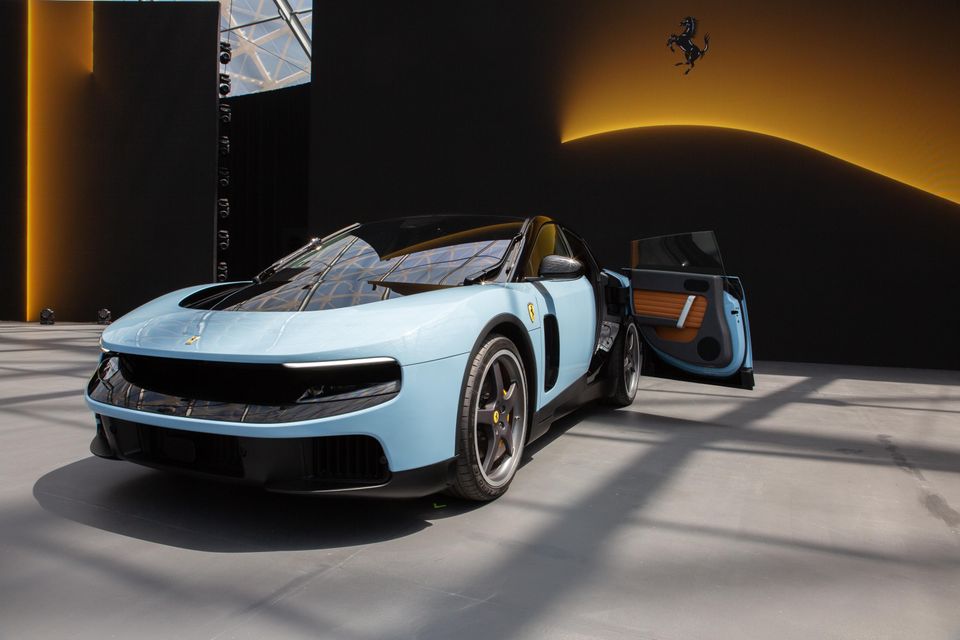
The auction car was not configured like an ordinary Ferrari Luce EV. Ferrari used its Tailor Made personalization program to create a one-off specification centered around the theme of light.
Its exterior features a special Madreperla Semi Gloss finish developed specifically for the car. The paint contains a dedicated pigment that can produce changing reflections ranging from green to violet depending on the lighting and viewing angle.
Inside, Ferrari selected Perla Le Mans metallic leather with Grigio Corvara details. The car also receives dedicated wheels, specially configured brake calipers, and a Ferrari logo positioned against an optical white background.
These details alone would not explain a $40 million price. The real value comes from combining the unique specification with Chassis 0 status and the historical importance of the car.
Performance Gives the Ferrari Luce EV Serious Credentials
The Ferrari Luce EV is not being introduced simply as a luxury electric vehicle. Ferrari has engineered it around the kind of performance expected from the brand.
The Chassis 0 specification uses four electric motors and produces around 1,050 horsepower according to ANSA’s reporting. That output puts the Ferrari Luce EV firmly into high-performance territory. Four motors also give Ferrari considerable freedom in controlling torque delivery and the behavior of the vehicle.
For everyday drivers, the interesting question is not simply how much power the Ferrari Luce EV produces. It is whether Ferrari can make an electric powertrain feel as engaging and emotionally distinctive as its famous gasoline-powered cars. That will ultimately be a more important test than the horsepower figure.
The $40 Million Sale Was About History, Not Normal Pricing.
It is important for buyers and enthusiasts to understand what this auction result actually means. The Ferrari Luce EV did not suddenly become a $40 million production car. Instead, one exceptionally important example reached $40 million because collectors were competing for the opportunity to own the first production chassis of Ferrari’s electric era.
The auction was also conducted for charity, which changes the context of the bidding. Ferrari is donating the entire proceeds to educational initiatives through The Ferrari Foundation.
In other words, the winning bidder was acquiring a historically important Ferrari while simultaneously contributing a huge amount to a charitable cause.
A 36 Times Increase From the Estimate
The numbers are remarkable. RM Sotheby’s listed the car at a value in excess of $1.1 million. The final $40 million result works out to approximately 36.4 times that figure. That is an extraordinary jump even by Ferrari collector car standards.
It also demonstrates why auction estimates should not always be confused with predicted final prices. An estimate provides a reference point, while the final result depends heavily on the number of serious bidders and the emotional importance they attach to a particular vehicle.
With Chassis 0, the pool of potential buyers was not simply looking for another Ferrari. They were bidding for the beginning of a new chapter in Ferrari history.
The Ferrari Luce EV Could Become a Collector Car
There is a fascinating question surrounding the Ferrari Luce EV. Will future collectors look back at it in the same way enthusiasts now view historically important Ferrari models from earlier eras? Nobody can answer that with certainty today.
However, the ingredients for future collectability are already present. The Ferrari Luce EV is Ferrari’s first fully electric production car, and Chassis 0 is the first production chassis from that program. That makes its historical identity extremely clear.
The larger question is how future Ferrari models will affect its significance. If Ferrari eventually produces many electric models, the Luce could become remembered as the car that started the transition.
If Ferrari’s electric strategy evolves in an unexpected direction, the first model could become even more significant.
Ferrari Luce EV Demand Has Already Drawn Attention
The auction result comes at a time when interest in the Ferrari Luce EV is already substantial. Reports from Italy indicated that Ferrari had reached its planned allocation for 2026 after around 500 cars were reserved, with strong demand reported from China.
There has also been conflicting reporting around the Chinese market. Some reports initially described an immediate sellout of the first allocation, while subsequent dealer checks suggested customers could still place orders. That means claims about a complete Chinese sellout should be treated cautiously.
This is a useful reminder that excitement around a new Ferrari can move faster than independently confirmed sales information.
Why Collectors May Be Interested
For a serious collector, the Ferrari Luce EV Chassis 0 offers several layers of significance. First, it is the first production example of Ferrari’s first fully electric model. Second, it has an individually developed Tailor Made specification. Third, it was sold through a major international collector car auction for a charitable purpose.
Those factors create a story that will remain attached to the car throughout its life. A collector buying an ordinary new Ferrari is purchasing a high-performance vehicle. The person who bought Chassis 0 purchased something that documents a specific moment in the history of one of the world’s most recognizable automotive brands.
The Biggest Advantage Is Its Historical Importance
The strongest argument for the Ferrari Luce EV Chassis 0 is not its acceleration or technology.
It is the story.
Every historically important Ferrari eventually becomes more than a machine. The most desirable examples carry stories about racing victories, famous owners, engineering breakthroughs, or major turning points for the company.
Chassis 0 already has one of those stories.
It is the Ferrari that opened the company’s fully electric chapter, and it now has a $40 million auction result attached to its history.
There Are Also Reasons to Be Cautious
The Ferrari Luce EV is undoubtedly significant, but enthusiasts should avoid assuming that every Luce will become a multimillion-dollar collectible.
The $40 million auction was an exceptional charity sale involving a unique chassis. It does not establish the future resale value of standard production examples.
Electric vehicle technology is also developing extremely quickly. Battery chemistry, charging systems, software, and electric motor technology can change substantially over the next decade.
That creates a different collecting environment compared with classic Ferraris whose mechanical technologies have remained relatively stable for generations.
What the Ferrari Luce EV Means for Ferrari
The Ferrari Luce EV is important beyond its specifications. Ferrari has traditionally sold emotion as much as transportation. Its customers expect technology to serve the driving experience rather than dominate it.
The company’s challenge with the Ferrari Luce EV is therefore much larger than building a fast electric car. Ferrari has to prove that electrification can preserve the sense of occasion that makes its cars special.
The $40 million Chassis 0 auction does not answer that question, but it shows that collectors already recognize the historical importance of Ferrari’s move into electric vehicles.
What Buyers Should Know
Anyone considering a Ferrari Luce EV should separate the regular production car from the extraordinary Chassis 0 auction result. The $40 million price is not a realistic benchmark for normal ownership. It reflects rarity, provenance, charity, and the emotional significance of being the first production example.
For future owners, the more relevant questions will be range, charging performance, everyday usability, driving dynamics, software, servicing, and long-term battery technology.
Those factors will determine whether the Ferrari Luce EV works as an actual Ferrari for its customers rather than simply as an important historical milestone.
Ferrari Luce EV Pros and Cons
Ferrari Luce EV Pros
- Exceptional performance potential
- Ferrari’s first fully electric production model
- Four-motor electric powertrain
- Around 1,050 horsepower
- Strong historical significance
- Highly customizable Tailor Made program
- Chassis 0 has extraordinary collector appeal
Ferrari Luce EV Cons
- Extremely high purchase price
- The $40 million auction result is not representative of regular market pricing.
- Electric technology can become outdated quickly
- Charging infrastructure remains important for long-distance use
- Long-term collector value remains uncertain
My Personal Opinion About This Sale
The Ferrari Luce EV has already entered Ferrari history before most customers have had the opportunity to experience one. The $40 million sale of Chassis 0 is extraordinary, but the headline price tells only part of the story. This was a unique first production chassis sold through a charity auction, not a normal Ferrari Luce EV changing hands for $40 million.
What makes the result genuinely interesting is what it says about Ferrari’s transition into the electric era. Collectors were willing to pay an enormous amount for the first physical symbol of that transition. For Ferrari, that is a powerful vote of confidence.
For the automotive industry, it is another sign that electric cars can become important collector objects when they carry genuine historical significance.
And for enthusiasts watching the story unfold, the Ferrari Luce EV may eventually be remembered as one of the cars that defined the moment Ferrari moved into a new technological era.
The WheelsWind Luxury Car category will be watching closely as the Ferrari Luce EV moves from historic launch vehicle to real-world customer car.